
Extraction: getting the liquid out first
Every gallon pulled out as liquid is one you will not have to evaporate later. Extraction equipment depends on depth and surface. Submersible pumps handle standing water several inches deep. Portable extractors work carpet and small areas. Truck-mount units, with their own vacuum power, move large volumes quickly.
On carpet and hard floors, weighted floor extractors press water out of fibers and pad. On hardwood and tile, squeegees and wet-dry vacuums pull surface water out of seams. Then the drying equipment takes over.
What drying equipment actually does
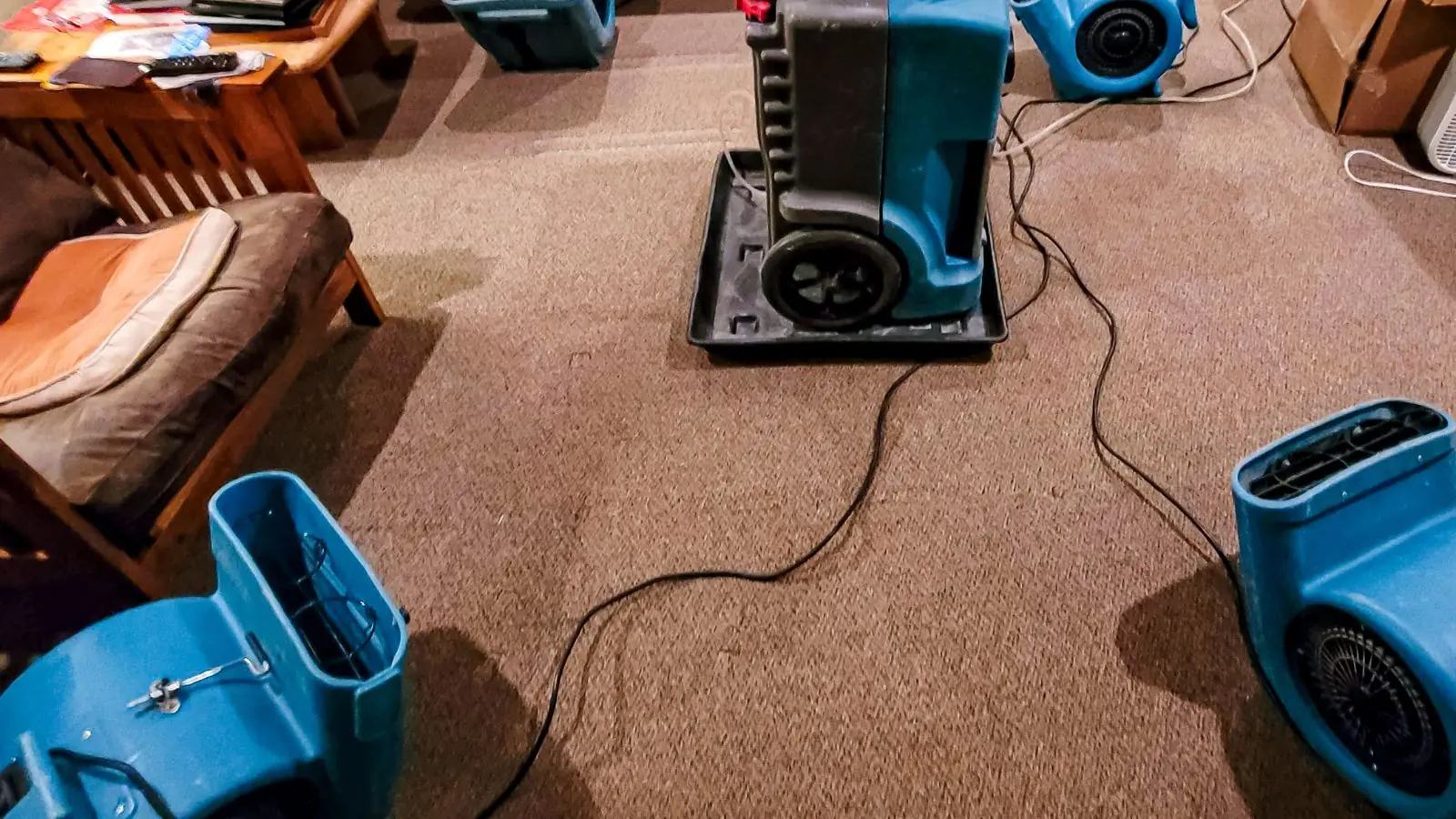
Air movers blow air across wet surfaces, and that breaks up the thin layer of humid air hugging the material so moisture can release. They are low pressure and high volume, often angled along walls or floors.
LGR dehumidifiers (low grain refrigerant) pull moisture out of the air, which keeps the room dry enough for more moisture to leave the structure. The two tools work as a pair, in a closed room, with the door shut. An air mover alone just moves wet air from one place to another.
- Injectable wall-cavity drying pushes dry air into closed walls through small holes, avoiding full demolition.
- Drying mats pull moisture through hardwood or tile using suction.
- HEPA air scrubbers clean the air when dust or contamination is present.
- Thermal imaging cameras help find wet spots, though they do not measure moisture directly.
Choosing among them depends on the materials. For the full drying phase, see our water damage cleanup page.
Dealing with standing water?
Call the 24/7 line.
How a crew decides the job is dry
Drying is judged with numbers. The crew takes moisture readings on affected materials and compares them with readings from an unaffected area of the same house, which sets a dry standard that fits your home. Readings are logged each visit.
When affected materials match that standard, equipment can come out. If a crew picks up equipment by calendar alone, ask to see the readings. ANSI/IICRC S500 expects measurement, and good providers share the log with you.
Equipment placement and count
Where the equipment sits matters as much as how much there is. Air movers should be directed at wet surfaces and corners, dehumidifiers need a sealed space, and equipment should not be blocked by furniture. A crew will adjust placement on day two based on readings.
How many units a job needs depends on the class of the loss, the square footage and the materials. A Class 1 spill is different from a Class 4 job in hardwood and plaster. Be wary of anyone who gives a count without measuring first.
Why timing changes the drying bill
Water moves into materials by wicking, and it keeps moving until something stops it. Drywall pulls moisture up from a wet baseboard, and pad passes it to the subfloor. Extraction started the same day limits how far that goes, which can mean fewer materials removed and fewer drying days.
Microbial growth can begin about a day after a leak, so a slow start raises the stakes. If drying stalls, a mold remediation assessment may be the next call. Cost factors include water category, square footage, materials, equipment days and rebuild scope, so a real number follows an on-site look.
Questions to ask any provider
| Question | A good answer | A weak answer |
|---|---|---|
| Do your crews work to ANSI/IICRC S500? | Yes, with a plain explanation of the steps | Vague or no answer |
| How will you prove the structure is dry? | Moisture readings against a dry standard in my home | We leave it for a few days |
| Will I get the drying log? | Yes, readings shared at each visit | Not necessary |
| What happens with wet walls and floors? | Meters, thermal imaging, possible injectable drying | We put fans in the room |
| Who explains scope and pricing? | Scope first, a number after assessment | A price over the phone with no visit |
| Is mold handled by licensed people? | Ask for the Texas license the work requires | We handle everything ourselves |
Honest limits apply here. This site dispatches restoration professionals and does not rent equipment, so you will not be handed a dehumidifier and a set of instructions. Cost depends on water category, square footage, materials and drying days, and a real number follows an assessment.
Before the crew arrives
Stop the water if you can by shutting the main valve. Turn off breakers for wet areas only if the panel is in a dry spot. If water touches outlets or the panel, stay out and call the electric provider or 911. Lift valuables and photograph everything.
State insurance guidance is to get standing water out, begin drying and save ruined items for the adjuster. Leave rebuilding for later. For active leaks, our emergency water removal page explains what dispatch looks like. Call (972) 945-2885 any hour for 24/7 dispatch and same-day response when available.
Reaching lake-area homes in Little Elm
The Town of Little Elm sits on Lewisville Lake, whose normal level is 522 feet. Crews reach lake-area homes along Eldorado Parkway, FM 423 and FM 720, and the route matters when traffic is heavy or roads are wet. Give your dispatcher the cross street you will meet them on and note any gate codes or narrow driveways.
The U.S. Army Corps of Engineers has scheduled a dam safety upgrade at Lewisville Dam for completion in 2026. It is useful context for homeowners to follow lake-level news, because high water can put basements and low yards at risk. Look up your address on the FEMA flood map and ask your insurer about flood coverage.
Once the crew is inside, ask them to walk the route water took, from the source to the lowest rooms. That conversation tells you whether they are thinking about the building or just the carpet.
Neighboring towns share the same lake shoreline, and crews also serve The Colony and Frisco from the same dispatch.
Frequently Asked Questions
How long will drying equipment stay in my home?
It depends on the materials, class and readings. Many jobs take several days. The equipment stays until moisture readings match the dry standard from your own home.
Can I rent the equipment and do it myself?
This site dispatches professionals and does not rent equipment. Consumer rental fans rarely come with moisture mapping, which is how you know whether structure is dry.
Are the machines loud, and can I stay home?
Air movers and dehumidifiers are loud and run day and night. For Category 3 water or heavy contamination, many people stay elsewhere, so ask your crew.
What is the difference between extraction and drying?
Extraction removes liquid water with pumps and vacuums. Drying uses air movers and LGR dehumidifiers to remove moisture absorbed in materials.
Why does the 2026 Lewisville Dam upgrade matter to a Little Elm homeowner?
The Corps of Engineers is scheduled to complete a dam safety upgrade in 2026, and lake-level news can affect low yards and basements. Following it helps you decide when to prepare belongings and review flood coverage.