
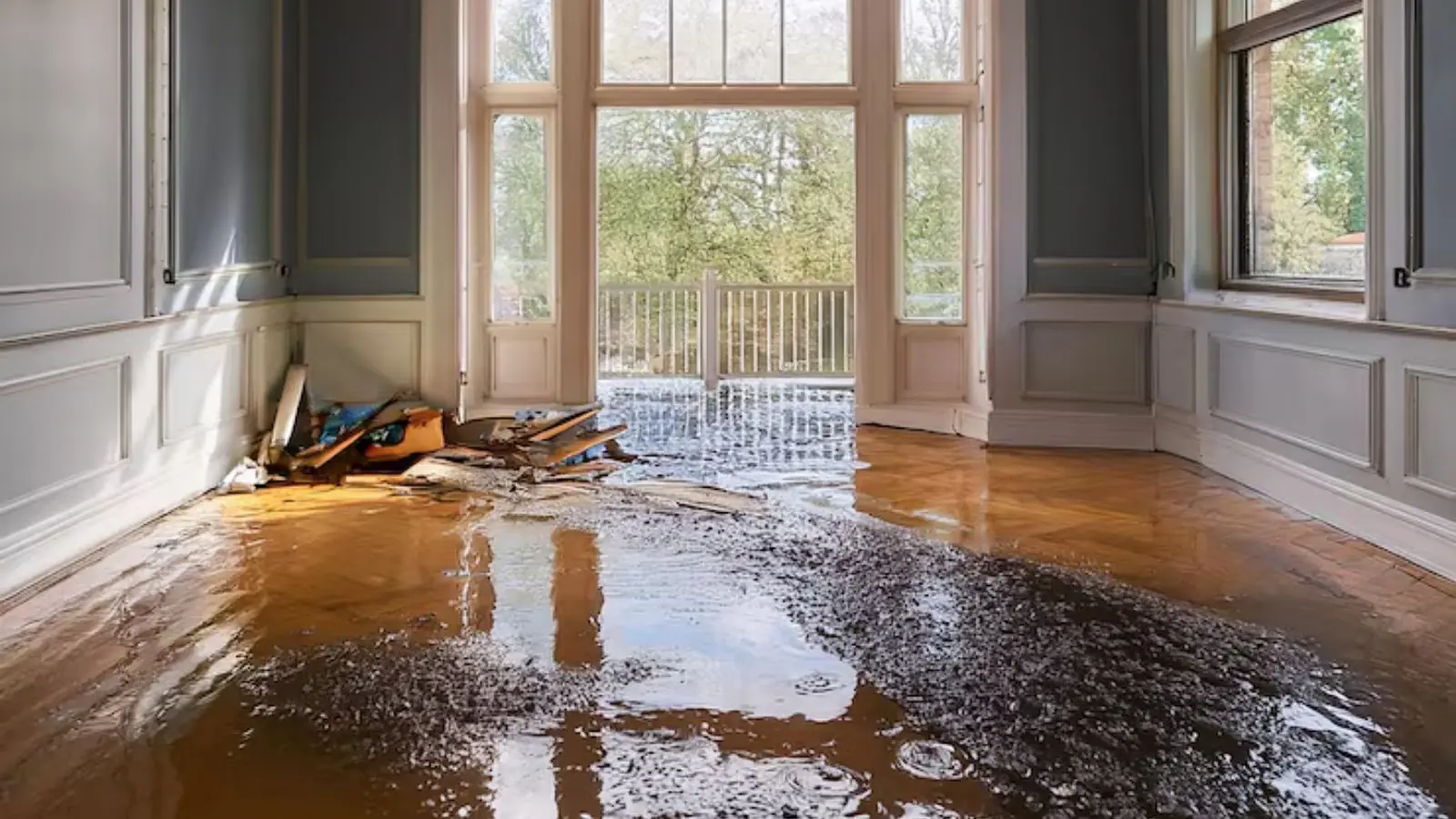
Why repair starts after drying, not before
Closing up a wall that still holds moisture traps it behind new paint, and the problem comes back as peeling, staining or odor. For that reason, repair begins when moisture readings match the dry reference, not when the surface looks fine. If drying has not been verified yet, start with our water mitigation service.
Repair is also where the earlier decisions pay off or cost you. A clean flood cut leaves a straight patch. Pad that was pulled early means the new carpet lays flat. Ask for the final moisture log before any rebuild is scheduled.
Ceiling and wall water damage repair
A yellow-brown stain means water reached the drywall at some point. A bubbled or sagging ceiling means the board is holding enough water to fail, and a collapsed ceiling means it has already failed. Sagging drywall should be handled carefully, since a poke with a broom often releases a lot of water at once, so place a bucket and a tarp first and keep people out from underneath.
The source comes first. In Texas homes, the usual culprits are roof leaks after a storm, an AC condensate line that clogs and overflows into the attic or closet, and a supply line over a bathroom. If the leak is still active, new drywall and paint will stain again. A roofer, HVAC technician or plumber fixes the source, and restoration handles the damage it caused.
Once dry, wet insulation above the ceiling is replaced, damaged board is cut back to framing and new drywall is hung, taped and floated. Small stains that dried completely may only need a stain-blocking primer and paint. A stain is a sign to check, since a ceiling can look finished and still hold a damp spot a few feet over.
Texture is the part people notice. Orange peel, knockdown and skip-trowel each have a pattern, and the patch has to be sprayed or hand-applied to blend. Painting the full ceiling or wall, edge to edge, hides the seams better than spot painting.
Need water damage repair in Little Elm?
Call the 24/7 line.
Hardwood floor cupping and drying
Cupping happens when the edges of a board rise higher than the center, because the bottom of the board absorbed moisture faster than the top. It shows up days after a leak, a washer overflow or high crawl space humidity. Crowning, the opposite shape, can follow if boards were sanded while still wet.
In many cases cupped boards can be dried and flattened, not replaced. Specialty mats and panels pull moisture from the floor surface, and dehumidifiers lower the humidity around it. This can take weeks, since solid wood gives up moisture slowly. Boards that are loose, split or black from long exposure are the ones that usually need to be replaced.
Patience pays off. If the floor is sanded before it is flat and at its normal moisture level, the cup comes back after refinishing. Wait for readings that match an unaffected area of the same floor, wait for the wood to settle, and only then sand and finish. Ask your flooring contractor to confirm the moisture reading before they start.
If only one room cupped and the rest of the floor is fine, matching new boards to old ones for species, width and stain is the next challenge. That is a good question for the installer.
Repair or replace: a quick decision guide
| Material | Usually repaired or dried | Usually replaced |
|---|---|---|
| Drywall | Small stain that dried fully, then primed and painted | Sagging, soft, crumbling or sewage-exposed board |
| Insulation | Rarely reused once wet | Wet batts and blown insulation above a leak |
| Hardwood | Mild cupping, boards that flatten as they dry | Split, loose or black boards, severe crowning |
| Laminate or vinyl plank | Rarely, if edges stayed sealed | Swollen or lifted edges and planks |
| Baseboard | Painted wood that stayed solid | Swollen MDF, which falls apart when wet |
| Cabinets | Solid wood boxes dried in place | Particleboard bases that swelled |
Particleboard and MDF are common in modern cabinets and trim, and they swell when wet, so kick plates and bases are the first parts to fail. If water reached your cabinets, the toe kick is a good place to check for swelling.
What restoration is not
Water damage restoration is not roofing, foundation repair or waterproofing. If a roof leaks, a roofer fixes the roof. If water keeps coming through a slab or basement wall, you need a foundation or waterproofing specialist. We rebuild what water damaged inside, and we can point you toward the right trade when the cause is outside our work.
That honesty saves money. Rebuilding a room before the leak is fixed only puts new materials in the path of the same water. When the cause is unclear, get the source diagnosed first and repair second.
Rebuild scope and permits
A rebuild scope lists each room, the materials to be replaced, the trades involved and the order of work. Usually it runs insulation, drywall, texture, primer, paint, then trim, flooring and cabinets. Reading it line by line before work starts helps you compare it with your insurer's estimate.
Whether a permit is required depends on the work, and larger rebuilds, electrical work and plumbing changes often involve one. Ask the Town of Little Elm building department about permits before work begins. Your contractor should know the answer and tell you who pulls it.
What affects the cost of water damage repair
Rebuild scope
Patching one ceiling section is a different job from replacing drywall, flooring and cabinets in a kitchen.
Materials and finish
Hardwood, tile, solid cabinets and custom trim cost more to match than basic builder-grade finishes.
Texture and paint matching
Blending texture and painting corner to corner adds labor but hides repair lines.
Square footage
More area means more drywall, paint and flooring, and often more drying days beforehand.
Hidden conditions
Wet insulation, damaged framing or mold found after demolition can change the plan.
A sudden pipe failure is the kind of loss TDI says policies often pay for, and a leak that went on for months is usually treated differently. Rebuilding is the step to hold back. Tarps and board-ups are fine as temporary fixes, but finished work should wait for the adjuster, so keep photos, receipts and the damaged pieces.
Any dollar answer before the scope is seen is a guess. Want your real number? Call (972) 945-2885.
Repair after a mold finding
If mold turns up when drywall comes down, rebuilding pauses. Mold needs moisture, so the cause must be fixed and the area handled under ANSI/IICRC S520 before new materials go in. See our mold remediation page, and before hiring anyone for it, confirm they hold the state license that mold work requires in Texas. Customers in Prosper deal with the same sequence.
Frequently Asked Questions
How soon after drying can the rebuild start?
As soon as moisture readings match the dry reference on two checks in a row and any hidden problems have been cleared. Rushing it risks trapping moisture behind new finishes.
My ceiling is stained but dry. Do I need to replace it?
Not always. If readings confirm the drywall is dry and solid, a stain-blocking primer and fresh paint may be enough. If the board is soft, bubbled or sagging, it should be cut out.
Can cupped hardwood be saved?
Often, if the cause has been fixed and the boards are given time to dry. Sanding too early is the usual mistake, so wait for moisture readings that match an unaffected area.
Will the new drywall match my old texture?
It can be matched closely when the pattern is identified first, such as orange peel or knockdown. Painting the whole wall or ceiling edge to edge hides the patch lines best.
Does a roof leak or AC condensate leak count as water damage?
The damage inside counts, but the roof or drain line itself does not. A roofer or HVAC technician fixes the source, and then the ceiling, insulation and paint are rebuilt.
Do I need a permit to repair water damage?
It depends on the scope. Ask the Town of Little Elm building department about permits, particularly for electrical, plumbing or structural work.