
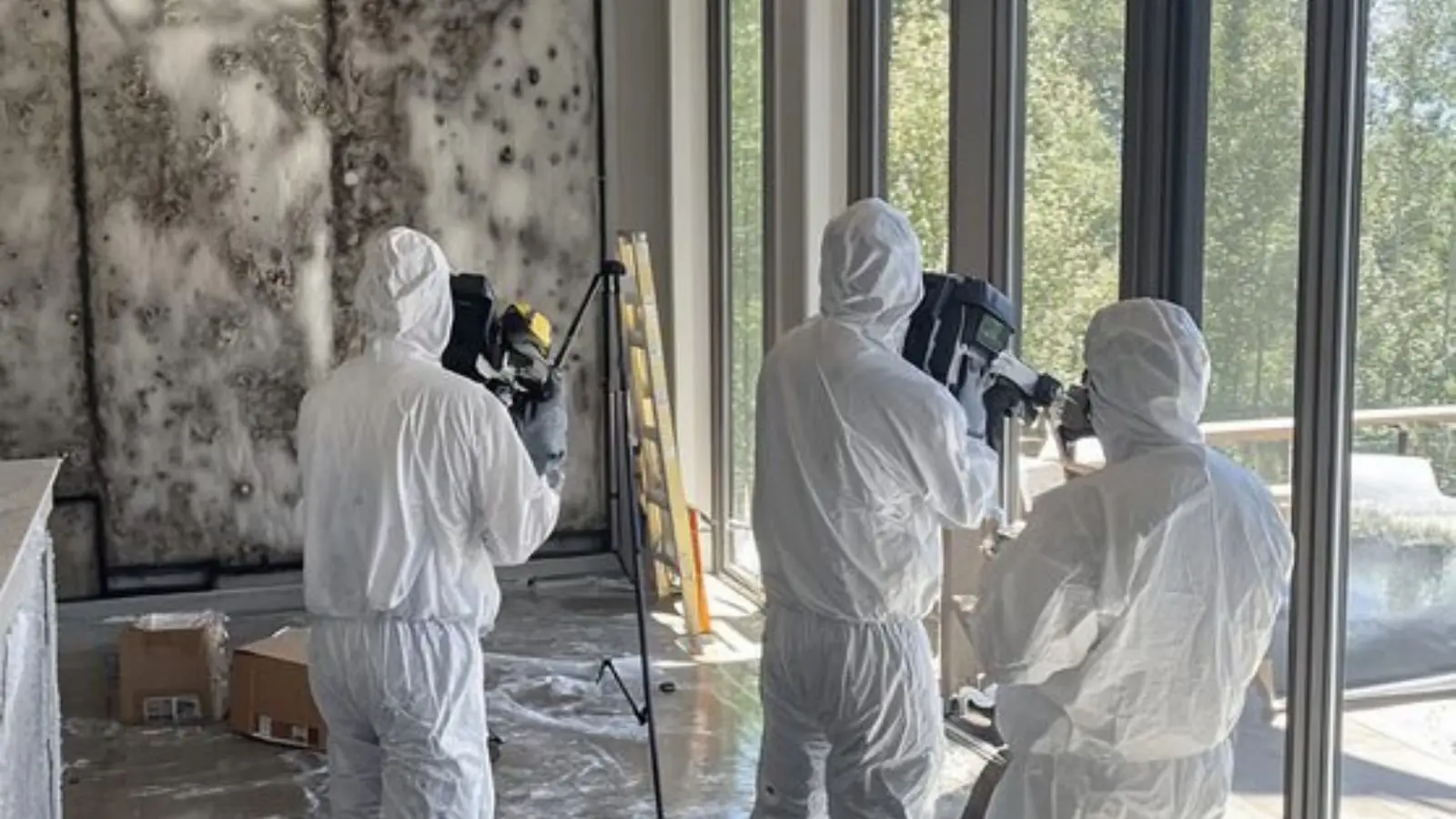
What mold needs and what to do first
Mold needs spores, a food source such as drywall paper or wood, and moisture. A house always has the first two, so moisture is where the work starts. The Texas Department of Insurance says mold can start growing within a day after a leak, though visible growth often shows up days later.
Stop adding moisture before you touch the mold. Fix the leak, keep the air conditioning running, and leave the area alone, since scrubbing or fanning it can push spores into clean rooms.
Remediation contains, removes and cleans mold-damaged material. Water mitigation, by contrast, dries a wet structure, and the two often run back to back.
Musty smell, dark spots on the ceiling, bubbling paint, a leak last month?
These are the signs people call about: a musty smell in a closet, dark spots on a ceiling, paint bubbling on a wall, a stain below a bathroom, or a sink that leaked last month and was only wiped up. Each points to moisture that stayed somewhere it should not. The trade term for finding that moisture and dealing with what it caused is mold assessment and remediation.
- A musty smell with nothing visible often means damp material behind a wall or under a floor.
- Dark spots on a ceiling usually trace back to a roof, attic, AC or upstairs plumbing leak.
- Bubbling or peeling paint means moisture is pushing out from behind the surface.
- A past leak under a sink can leave wet cabinet backing and drywall that never fully dried.
Need mold remediation in Little Elm?
Call the 24/7 line.
Mold removal and black mold cleanup
Black mold is a color, not a diagnosis. Many mold types look dark, and only laboratory analysis of a sample can name a species. The cleanup is the same whatever the color: contain it, remove contaminated material, clean what stays and fix the moisture.
Removal depends on the material, and it is the slowest part of the job. Porous items carrying growth, such as drywall, insulation, carpet and ceiling tile, are cut out, bagged and taken away. Framing and other structural wood is HEPA vacuumed, abraded where the protocol calls for it, wiped with detergent cleaner and dried. Antimicrobial treatment may follow, and all removed material leaves the home in sealed bags.
Size changes the rules. Texas has a minimum-area exemption of 25 contiguous square feet for small cleanups by unlicensed persons. Above that, ask whether the person you hire holds the Texas license TDLR requires for the work, and get the answer in writing.
Mold after water damage: dry first, then remove
Mold after water damage is a timing problem. Wet drywall, carpet pad and framing that stay damp past the first day or two give growth what it needs. Fast drying under ANSI/IICRC S500 is the best defense, and the water mitigation page shows how crews do it with air movers and LGR dehumidifiers, usually over several days.
If growth is already there, the order matters. The leak source must be fixed first, or the cleaned area gets wet again. Then wet and affected material is removed and the structure is dried. Water damage cleanup covers sanitizing and contents, while remediation handles growth that has set in.
A ceiling stain, a wall that feels cool and damp, or hardwood cupping near a wall can mean moisture has been present for a while. Moisture meters and thermal imaging cameras find wet material behind surfaces without opening everything. Crews check these readings again at the end, so a surface that looks dry is not taken on faith.
Mold testing and inspection: assessment is a separate license
An inspection looks for visible growth, odor, water stains and, most of all, the moisture source. The assessor walks the home with moisture meters and thermal imaging, may take air or surface samples, and maps which materials are wet and how far it spreads through the home, room by room.
Texas keeps assessment and remediation apart. TDLR licenses mold assessment consultants and technicians, and it separately licenses mold remediation contractors. A licensee may not do both the assessment and the remediation on the same project, so the person writing the scope is not the person paid to carry it out.
The assessor writes a protocol and the remediator follows it. When the work is finished, a licensed remediator issues the Certificate of Mold Damage Remediation. Check the license in writing before work starts. Owners working on their own home and builders under a builder warranty have exemptions.
How remediation follows ANSI/IICRC S520
ANSI/IICRC S520 is the published mold remediation standard, so ask any company whether its crews work to it. The sequence repeats on every job:
- Containment: plastic sheeting and containment barriers seal the work area so spores stay put.
- Negative air: HEPA air scrubbers pull air through filters and hold the area at lower pressure than the rest of the house.
- Removal: mold-damaged porous materials are cut out, bagged and carried out sealed.
- Cleaning: remaining surfaces are HEPA vacuumed and wiped, and antimicrobial treatment is used where the protocol calls for it.
- Verification: the area is checked visually and, where the protocol requires, tested by an independent assessor.
Your options compared
| Option | Fits when | What it does not do |
|---|---|---|
| Small homeowner cleanup | A spot under 25 contiguous square feet, leak already fixed | Find hidden moisture or give you a certificate |
| Assessment only | You want to know what is there, how far it goes and what the protocol should say | Remove anything |
| Licensed remediation | Growth is larger, hidden, or needs paperwork for an insurer or a sale | Fix the leak or promise it will not return |
| Water mitigation first | Materials are still wet from a recent leak | Remove growth that has already set in |
Mold and your insurance policy
Texas Department of Insurance guidance is plain. Most policies cover sudden, accidental water damage, and mold on a covered damaged item is covered. Gradual leaks and the mold they cause usually are not.
Most policies also exclude mold cleanup and testing after the damaged item is removed, unless you added that coverage, so ask your agent. For a mold claim, use a state-licensed mold professional, expect an inspection confirming removal and that the cause was fixed, and get a certificate from the professional confirming the removal. Report the claim as soon as possible.
What drives the cost of mold work
| Factor | Why it changes the scope |
|---|---|
| Area affected | Square footage and how many rooms are involved set labor and containment |
| Materials | Drywall and insulation come out while framing is cleaned |
| Access | Attics and crawl spaces take longer to contain and clean |
| Assessment and verification | Inspection, protocol and clearance testing are separate line items from removal |
| Moisture source | Fixing the leak and rebuilding afterward are separate from remediation |
Check your policy, since sudden and gradual water are treated differently. A real number comes after the area is assessed. We also take mold calls from nearby towns such as Prosper. Want your real number? Call (972) 945-2885.
What mold work cannot promise
We do not make health claims or diagnose anything. Symptoms are a question for a physician. Remediation addresses the building, not the person.
No one can promise mold will not return. If moisture comes back through a roof leak, a failing drain or high humidity, growth can follow. The best protection is fixing the cause, which may take a plumber, roofer or AC technician, water damage repair covers the rebuild after clearance.
Frequently Asked Questions
There's a musty smell but I can't see anything. Is it mold?
A smell alone cannot tell you. It usually means damp material somewhere, and an inspection with moisture meters and thermal imaging is how you find it.
Can I get mold clearance for a home sale or loan?
Buyers, lenders and inspectors sometimes ask for documents after mold work. The usual ones are the Certificate of Mold Damage Remediation from the licensed remediator and independent clearance testing by a licensed assessor. We cannot promise what any lender will accept, so ask yours what it needs.
Can I clean mold myself?
Owners doing the work on their own home are exempt from licensing, and unlicensed persons have a 25 contiguous square foot exemption for small cleanups. If the spot is larger or keeps returning, the moisture is still there.
Will insurance pay for mold?
Mold on a covered damaged item is usually covered, but gradual leaks and the mold from them usually are not. Mold cleanup and testing are often excluded unless you added the coverage. Check your policy or ask your agent.
Will the mold come back after remediation?
No honest company can promise otherwise. Mold returns when moisture does, so the leak, drain, roof or humidity problem has to be fixed.