
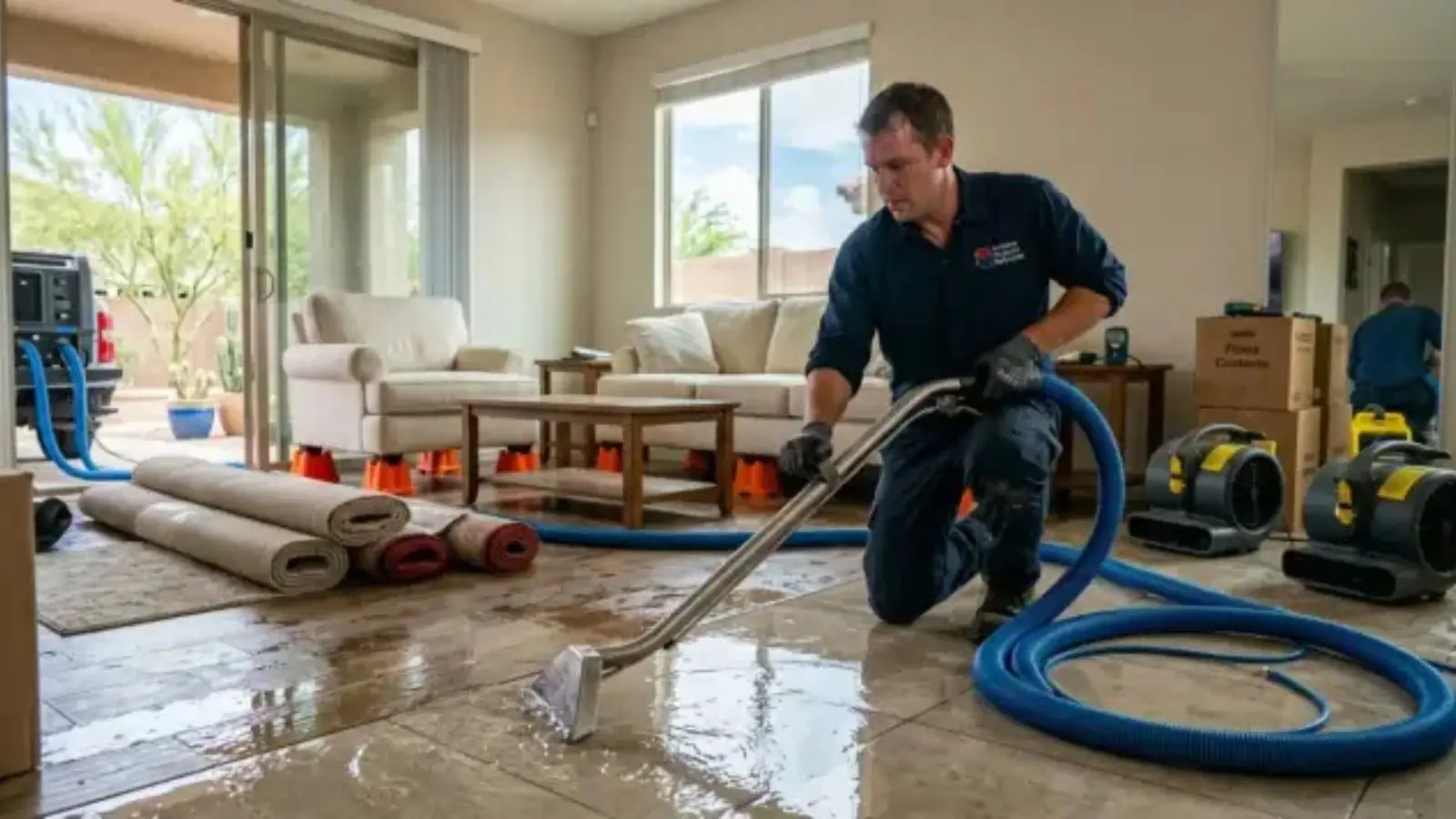
When standing water is an emergency
If water is standing in your home right now, call our 24/7 dispatch line and then start on the steps that limit the damage. Stop the source, which usually means closing the main water valve. Lift furniture legs, rugs, books and electronics out of the water, and keep people and pets away from anything that may be contaminated.
Cut power to the wet area only if you can reach the panel without stepping into water. If you cannot, leave it alone and read the safety block further down. We offer same-day response when available, evenings and weekends included.
Take quick photos or a short video of the water and the rooms before you move anything, since TDI advises documenting damage for your insurer. Every extra hour of standing water spreads moisture into baseboards, drywall and subfloor. That is why extraction starts before any drying plan is final.
Burst pipe water damage: find the shutoff first
Find the main water valve before anything else. In many homes it sits at the meter, in a garage or in a utility closet. If you cannot turn it, ask the Town of Little Elm, which bills water to residents, who to call for a shutoff at the meter.
Where the pipe broke changes the job. A burst under a sink is easy to spot and is often limited to a cabinet base and a patch of floor. A break inside a wall can soak insulation and drywall for hours before a stain shows. On a second floor, water runs down through the ceiling below, so the first sign may be a bulge in the room underneath.
A failed braided supply line sends clean Category 1 water at full pressure until the valve is closed. A washer valve or hose break behaves the same way, while a washer drain overflow is Category 2. Close the fixture valve or the main, then call.
The February 2021 freeze is a local lesson. DFW hit -2 F on Feb. 16, 2021, and the area averages 29.2 days a year at or below 32 F, so freezes are not rare. Insulate exposed pipes in garages, attics and exterior walls, and learn where your shutoff is before the next cold snap.
Need emergency water removal in Little Elm?
Call the 24/7 line.
How extraction works, in plain words
Extraction is the physical removal of water, and the tool depends on how much there is and what it is sitting in. Crews carry a handful of tools for it:
- Submersible pumps clear deep standing water from floors, garages and crawl spaces.
- Truck-mount or portable extraction units pull water out of carpet, pad and hard floors.
- Weighted extractors press down on carpet to squeeze out water that a wand cannot reach.
- Moisture meters and thermal imaging cameras show where water is still hiding in walls and subfloor.
Carpet pad is the sponge in the floor. It holds water long after the carpet feels dry, and pad that sat in gray or black water is removed rather than dried. Pad from a clean source can sometimes be dried in place if it is caught early.
Drywall follows a similar rule. Panels that are only damp at the baseboard from clean water can often be dried, while panels that are sagging, crumbling or touched by contaminated water are cut out. Once the bulk water is gone, the water mitigation stage uses air movers and LGR dehumidifiers to finish the job.
Where the water came from decides the first move
| Source of the water | Category | First move |
|---|---|---|
| Burst or leaking supply line | Category 1 | Close the main valve, extract, start drying early |
| Washer or dishwasher discharge | Category 2 | Stop the appliance, extract, remove pad if it stayed wet |
| Rain-driven intrusion at a window or roof | Category 2 or 3 | Tarp or cover the opening, extract, check insulation |
| Irrigation line or backflow device | Category 2 or 3 | Shut the irrigation supply, pump, check what the water touched |
| Sewage backing up from a drain | Category 3 | Stay out, call the line, protective gear and removal |
Five emergencies we are called to, and how each is handled
Bathroom leak and a collapsed ceiling
Stay clear of any bulge, shut off the water and call. Crews remove the failed drywall and insulation, extract the floor below and dry the cavity.
Burst pipe under a sink
Close the valve at the fixture or the main. The cabinet base, toe kick and nearby flooring are checked with moisture meters, and wet material is pulled.
Whole-house flooding
Water through several rooms becomes a larger project. Our flood damage restoration page covers storm water, groundwater and Category 3 cleanup.
Irrigation backflow in a crawl space
A broken irrigation line can run for days unseen. Crews pump the space, remove wet insulation and dry the framing.
Rain-driven intrusion
Wind-driven rain through a window or a roof leak soaks ceilings and walls. Make temporary repairs such as a tarp, and leave the permanent ones until your insurer sees the damage.
Safety before extraction
Do this before you call us
If water touches an electrical panel, outlets or a light fixture, stay out of the room. If you smell gas, leave the house. Call the electric utility, the gas utility or 911 for any electrical or gas risk before you call the restoration line.
If sewage is involved, stay out of it, keep children and pets away, and wait for crews who wear gloves, boots, coveralls and respirators. If anyone feels unwell after contact, call a physician, and call 911 for severe symptoms.
What drives the cost of water removal
| Factor | Why it changes the scope |
|---|---|
| Water category | Clean, gray and black water call for different removal and cleaning |
| Square footage | More wet floor area means more extraction time and more equipment |
| Materials | Carpet, pad, hardwood and drywall are saved or removed on different rules |
| Drying time and equipment | The number of air movers and dehumidifiers, and the days they run, follow the moisture readings |
| Rebuild scope | Replacing flooring, drywall and paint is separate from removal and drying |
Sudden, accidental water such as a burst pipe or a broken washer hose is often covered, while gradual leaks usually are not, so check your policy or ask your insurer. We explain the scope before work begins, and a real number comes after someone has looked at it. Want your real number? Call (972) 945-2885.
We serve neighboring towns from our Little Elm base too, including Frisco, where the city keeps an on-call Public Works employee for water lines and valves around the clock.
Frequently Asked Questions
Do you handle water removal emergencies at night or on weekends in Little Elm?
A pipe that lets go at 2 a.m. or on a Sunday gets the same handling as a Tuesday morning call. Close the valve if you can do it safely, say what is wet, and a pump crew is sent from our Little Elm base, same-day when available.
Is water removal the same as water damage cleanup?
No. Removal is extraction, the first step, where pumps and extraction units take the bulk water out. Drying, sanitizing and clearing contents come after, and our water damage cleanup page covers that side.
Can wet carpet and drywall be saved?
Sometimes. Carpet and drywall wet by clean water and caught early can often be dried, while anything touched by sewage or flood water is usually removed. A moisture meter reading on site settles it.
What should I photograph before the crew arrives?
Take wide shots of each wet room, close-ups of the water line on walls, and the source if you can see it. List damaged property and keep receipts, and keep damaged items until the adjuster sees them. Do not make permanent repairs before your insurer looks.
Do you waterproof basements or inspect foundations?
No, and we will say so plainly. Waterproofing, grading and foundation inspection are a different trade. We remove water, dry the structure and clean it. If water keeps coming back after rain, you want a waterproofing contractor or a foundation specialist, and we can tell you what we see.
Can I turn off power myself?
Only if the panel is dry and you can reach it standing on dry ground. If the panel, outlets or the floor around them are wet, do not go near them and call the electric utility or 911 first.